

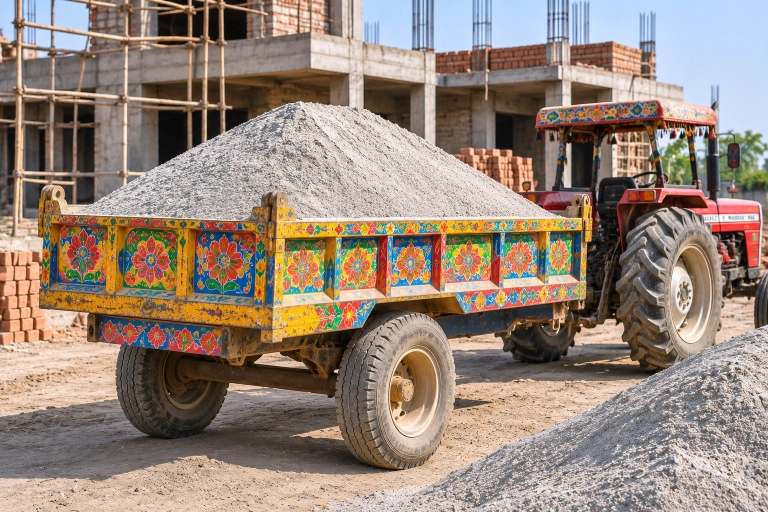
Sand Trolley Rate in Pakistan 2026: Rait Trali Price
The price of a 200 cft sand trolley in Punjab ranges from PKR 8,000 to 19,000, depending on the type of sand. Based on the rates published on 23 October 2026, Ravi is at the low end, and A-grade Chenab is at the top. The sand trolley rate in Pakistan is also variable based on distance, season and trolley size in Pakistan, so always check before paying.
Sand Trolley Rate in Pakistan Today
To calculate the sand trolley price in Pakistan, suppliers first determine the rate per cft and multiply it by the trolley’s total capacity. Here’s a table showing the same rates converted to a 200 cft trolley, to enable the comparison of quotes.
| Sand Type | Location | PKR per cft | PKR per 200 cft trolley | Source |
| Ravi sand | Punjab market range | 40 to 55 | 8000 to 11,000 | Bajriwaly |
| Chenab sand, regular | Punjab market range | 55 to 80 | 11,000 to 16,000 | Bajriwaly |
| Chenab sand, A-grade | Punjab market range | 75 to 95 | 15,000 to 19,000 | Bajriwaly |
| Chenab sand, delivered | Islamabad | 110 | 22,000 | Margalla Crush |
| Pit sand | Lahore | Not stated | 7,998 | Pakistan Bureau of Statistics, via Milkiyat |
The difference in rates of PKR 20 to 30 per cft may be attributed to freight only. Inquire from each supplier which one they send you. Note that the sand trolley rate in Pakistan varies from time to time, so it is just a reference and should not be considered a quotation.
Any quote can be compared by dividing the trolley price by its cft. The cost of 150 cft of a trolley is PKR 12,000. It is a much better deal than the same price for 200 cft, which is PKR 60. When comparing the sand trolley price in Lahore, buyers should also keep in mind that the Ravi River is dredged near the city, meaning haulage can remain short.
How Much Sand Is In One Trolley?
Standard tractor trolley size is 120-250 cft, depending on the size of the body. Suppliers seldom specify the size they are referring to, and that difference affects your bill more than the rate.
Small Trolley vs Dumper Load in cft
- Standard tractor trolley: 120 to 150 cft
- High-body tractor trolley: 200 to 250 cft
- 6-wheeler dumper: 400 to 450 cft
- 10-wheeler dumper: 700 to 800 cft
Take only one measurement of the body. cft = length x width x depth (all in feet). There are online lists that refer to a 900 cft dumper load as a trolley, so make sure to request the cft in writing.
Ravi Sand Vs Chenab Sand: Which To Use Where
Use Chenab for structure and Ravi for finishing. The difference lies in their grain size, which is expressed as fineness modulus (FM). The fine and rounded sand is described as Ravi sand, and its FM is between 1.0 and 1.5. The FM of Chenab sand is between 1.8 and 2.4, and it is coarser and sharper.
Sand For Plaster
Fine Ravi sand gives a smooth coating on the interior walls and is suitable for brick mortar (chunai), so plan it alongside your bricks after checking the current brick rate in Lahore. Sieved Chenab or washed Ghazi sand is more rain-resistant for outer walls.
Sand For Concrete And Masonry
Coarse Chenab/Lawrencepur sand is required for slabs, beams and foundations. Fine Ravi sand will require additional water for use in concrete, which will reduce the strength. Do not use it for roofs and columns. Concrete also needs crush, so check the bajri price in Pakistan before you order both materials.
The fine sand from Lawrencepur, which was quarried around Attock, is high-quality sand. It is listed at PKR 110 to 145 per cft on 23 October 2026, or PKR 22,000 to 29,000 per 200 cft trolley. If you are looking for A-grade Chenab for a normal house, it will do the same work for less, unless your engineer says otherwise, in which case you should choose Lawrencepur.
What Changes The Rait Trali Price In Pakistan?
Five factors affect the sand rate in Pakistan:
- Distance: Near Lahore, the distance of Chenab and Ravi begins at around PKR 35 per cft at the loading point. The transport is tacked on.
- Season: Monsoon extraction caps reduce supply and lift rates.
- Quality: A-grade Chenab ranges from PKR 75 to 95 per cft, as compared with the price of regular,r which is PKR 55 to 80 per cft.
- Moisture: The amount of moisture will cause the volume of sand to expand by 20 – 35 per cent, so the amount of dry sand you will receive will be less than the cft indicates.
- Mining rules: Quotas and bans on extraction increase rates and reduce supply.
Two bad habits prevent you from paying too much. First of all, you may have to believe the length of your trolley’s body yourself, as a heaped load charge at a discounted price is very prevalent. Secondly, reject wet sand or accept a reduced rate, as the sand is paid at cft and is being delivered with water.
How To Check Sand Quality On Site
- Fill a clear jar one-third with sand.
- Add water to two-thirds and shake hard for 60 seconds.
- Leave the jar still for three hours.
- Determine the thickness of the muddy layer on top. Above 6- 8 per cent of the entire height, reject load for structural works.
Rub a pinch in your palms as well. The clean sand is gritty and runs off, and the clay leaves a dark stain. But apply a thin layer in the sun too on white paper. When heavy glitter is present, it indicates the presence of mica, and a white crust indicates the presence of salts, which can cause corrosion of steel.
How Much Sand Does A 5 Marla Or 10 Marla House Need?
A 3000 cft sand requirement is used in a 5 marla grey structure for purposes of foundations, masonry, concrete and plaster. It is approximately 6 to 8 trolleys of 200 cft. The larger the built area of a house, the more quantity it will have. However, floors and basements will change it. Draw the figure and then obtain the figure from your drawings. You should specify the sand you want by using sand for slabs and columns and sand for plaster so you can order each type on the appropriate trolley count in your thekedar. If you would rather not manage sand orders yourself, our construction company in Lahore handles sourcing for the full grey structure.
Conclusion
One of the lines in the budget is sand. For the complete amount, check our Lahore cost of construction page. More is in the list of prices of construction materials in Pakistan.
FAQs
What Is the Pakistan Sand Trolley Price 2026 in Lahore?
According to the Pakistan Bureau of Statistics (PBS) survey of August 2026 in Lahore, the price of pit sand is approximately PKR 7,998 per trolley. The rait trolley price in Pakistan for a 200 cft trolley of Ravi or Chenab sand ranged from PKR 8,000 to PKR 19,000 on 23 October 2026.
How many cubic feet are in one sand trolley?
Standard tractor trolley capacity is 120-150 cft. The high body trolleys have a capacity of 200 to 250 cft. Dumpers can carry from 400 cft up to 800 cft (depending on the vehicle), so always check the vehicle before comparing prices.
Which sand is best for plaster in Pakistan?
Internal plastering uses fine Ravi sand. Sieved Chenab or washed Ghazi sand is used for external walls.
Is Chenab sand better than Ravi sand?
Both Chenab and Ravi are good for structure; Ravi is better for finishing. Slabs and foundations use Chenab, while Ravi can be used for internal plaster and mortar. Both are right, but both have roles.


Construction Materials Prices In Pakistan Updated 2024
November 25, 2026[…] Sand Trolley Rate in Pakistan 2026: Rait Trali Price […]
Bricks Rate In Lahore 2026: Updated Prices, Types, And Expert Buying Guide - The M Square
November 25, 2026[…] several hundred to thousands to your final brick cost range. The same transport factor drives the sand trolley rate in Pakistan and the bajri price in Pakistan, so order your materials together where […]
Bajri Price In Pakistan 2027: Crush And Aggregate Rates
November 25, 2026[…] 250 cft, a tractor trolley 500 to 600 cft, and a six-wheel dumper 800 to 900 cft. Please check our sand trolley rate in Pakistan guide for current sand […]